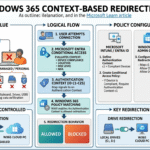
Windows 365 Microsoft Intune Microsoft Entra ID Conditional Access Preview feature In this post Why it mattersWhat it isHow it worksBefore you startWalkthroughValidatingBest practicesConclusion Why redirections deserve a second look A Cloud PC keeps corporate data in the cloud, but clipboard, drive, printer and USB redirection can quietly carry that data back to whatever device
Windows 365 Microsoft Intune Windows App Preview We all know the ticket: “My Cloud PC is misbehaving — can you reset it?” The Windows App settings policy in Microsoft Intune lets you hand that self-service power to exactly the right people, group by group, without a help desk round-trip. Here is how to set it
I have received my Microsoft Frontier Transformation Engineer badge On 22 October 2026, I received the Frontier Transformation Engineer badge from Microsoft, at the TITAN level. It’s a milestone I’m proud of, and I want to share it with the WhyAzure community. This post covers what the badge is, why the idea behind it matters
Windows 365 Cloud PCs live in Azure, but who gets local admin rights on them is entirely up to you. Windows 365 · Microsoft Intune Sooner or later, someone on your team will say: “I can’t install my tools on my Cloud PC.” If you manage Windows 365 (W365), the cleanest fix is a single,
Overview Before you begin Steps 1–2: Basics Step 3: Configuration Disaster recovery Steps 4–5: Scope & assignments Step 6: Review After you create it Quick reference Overview A Windows 365 Cloud PC settings policy in Microsoft Intune turns Cloud PC features on or off for a group of users, even after their Cloud PCs are
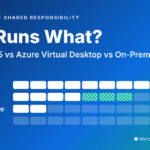
Cloud PC & VDI · Shared Responsibility Who Runs What? Windows 365 vs Azure Virtual Desktop vs On-Premises VDI Eleven layers, four delivery models, one question every architect should answer before signing off a desktop strategy: whose job is it? Why it matters The visual Layer by layer Each model How to choose Why a
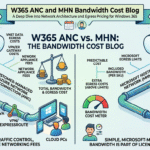
Licences get all the attention in a Windows 365 plan, but outbound data can quietly become a real Azure line item, or a hard ceiling your users bump into. Here is how each network option handles it. What is outbound data? ANC pricing MHN allowance Side by side Which to choose Cost tips When organisations
Windows 365 promises a simple idea: a personalized Windows desktop, streamed securely from the Microsoft cloud to any device. But “simple for the user” does not mean “no preparation for the admin.” Here is what the service expects before you provision your first Cloud PC. Azure Entra ID & Intune Domain Management Roles & Identity
1. Overview An Azure network connection (ANC) is the Windows 365 object that links your tenant’s Cloud PCs to an Azure virtual network (vNet) that you own and manage. The ANC is what allows Cloud PCs to be provisioned inside your organization’s network, domain-joined where required, and reached by Intune for ongoing management — instead
What it is, when to choose it, what you need in place, and the mistakes to avoid. Two networking models What is an ANC? Requirements Connectivity options When to choose BYON Setup steps Common pitfalls When you provision a Cloud PC, the first question is not about the OS image or the SKU. It is
Azure Virtual Desktop (AVD) has traditionally meant one thing: session hosts running as Azure virtual machines, brokered by a control plane that also lives in Azure. That assumption no longer holds. Microsoft now documents two distinct ways to keep AVD session hosts outside a standard Azure VM: AVD Hybrid and AVD on Azure Local. They
Microsoft is reworking how Azure Virtual Desktop handles network interruptions. The new approach, currently rolling out as Modern Auto-Reconnect, moves away from the retry-based model AVD has used for years and replaces it with a connection preservation model built on RDP Multipath. Here’s what’s changing, why it matters for end users, and what admins need
Remote Help lets your helpdesk team screen-share, chat with, and (with the right permission) take elevated control of a user’s session — including AVD multi-session hosts where several users can be active on the same VM at once. This is a two-part walkthrough. Part 1 covers enabling Remote Help at the tenant level and doing
Reclaiming host pool capacity from disconnected sessions is one of those AVD hygiene tasks that’s easy to configure once by hand in Intune, and easy to forget to replicate consistently across every host pool, tenant, or DTAP environment you manage. If you’re standing up host pools programmatically — or you just want this baked into
On July 15th, 2026, I received my 5th Microsoft MVP award — and once again, it’s a dual award, recognizing my contributions in both Azure Virtual Desktop (AVD) and Windows 365. This one feels different. Not because the process changed, but because of what it represents: five consecutive years of being recognized in Azure Virtual
If your AVD environment is built entirely on cloud-only or external Entra ID identities — no on-prem AD, no Entra Domain Services — you can still give users FSLogix roaming profiles on Azure Files. Microsoft Entra Kerberos handles the ticket issuance, so the storage account can authenticate users over SMB without any line-of-sight to a
How to pull reliable last-logon data for Azure Virtual Desktop users straight from Log Analytics — without hand-rolling REST calls or asking an LLM to stitch your query results back together. Why last logon matters for AVD If you run AVD at any real scale, ‘when did this user last actually log on’ turns out
If you’ve ever sat in a design workshop and had someone ask “so which identity model should we use for AVD?”, you know it’s rarely a one-line answer. Identity is the foundation every other AVD decision sits on top of — FSLogix profile containers, MFA policy, Conditional Access, session host domain join, even how Single
What Are Context-Based Redirections? Context-Based Redirections is a Preview feature in Azure Virtual Desktop that lets you control peripheral and device redirection — clipboard, drives, printers, USB — based on the compliance state of the connecting device, rather than applying a blanket allow or deny for all users. Instead of a binary on/off toggle on
This is Part II of a two-part series. In Part I (whyazure.in), we walked through Error 0x3000047 — a session host showing Unavailable while the VM itself was perfectly healthy. We diagnosed a broken RDAgentBootLoader, attempted a scripted reinstall that hung on stuck services, fell back to GUI installers, hit MSI error 1603 from a
Every Citrix Virtual Apps and Desktops, StoreFront, or NetScaler deployment eventually comes back to the same quiet, unglamorous component: the License Server. Nothing in the environment will check out a license, and admins will not get usage data, unless this piece is installed and configured correctly. This walkthrough covers the full process from running the
If you manage Azure Virtual Desktop (AVD) long enough, you’ll eventually hit a session host that looks perfectly healthy in the Azure portal — VM running, network fine, disk attached — yet refuses to let anyone connect. Here’s a walkthrough of one such incident, the error code behind it, and the troubleshooting path that eventually
Azure Virtual Desktop (AVD) has become the go-to solution for enterprises delivering scalable, secure, and cost-effective virtual desktops in the cloud. However, running Windows session hosts in the cloud does not make them immune to threats — quite the opposite. With users connecting from diverse endpoints and networks, AVD environments present an attractive target for
A Layered Security Strategy Azure Virtual Desktop is not just another workload. It is the front door to your enterprise — a surface where hundreds of users connect daily, carrying credentials, accessing sensitive data, and running line-of-business applications on shared infrastructure. Yet in many organizations, AVD security is treated as an afterthought: a single policy
Today I am going to share with you a production-ready Intune Detection & Remediation script pair for enforcing RDP Shortpath configuration on session hosts running Azure Virtual Desktop. These scripts are designed for deployment using Proactive Remediations in Microsoft Intune. Scenario Covered This pair ensures: UDP transport is enabled Managed Private Shortpath is enabled Managed
Choosing between Azure Virtual Desktop (AVD) and Windows 365 (W365) is not just about delivering a cloud desktop — it’s about aligning the solution with your organization’s size, complexity, scalability needs, and IT maturity. Based on the uploaded presentation, the positioning of both solutions clearly highlights their architectural intent and operational differences . Let’s break
As organizations accelerate their cloud transformation journey, Desktop-as-a-Service (DaaS) solutions are becoming central to modern workplace strategies. Microsoft offers two powerful solutions in this space: Azure Virtual Desktop (AVD) and Windows 365 (W365). While both deliver Windows desktops from the cloud, their architecture, management model, scalability, and cost structures differ significantly. This blog provides a