Earning the Microsoft Frontier Transformation Engineer Badge (TITAN)
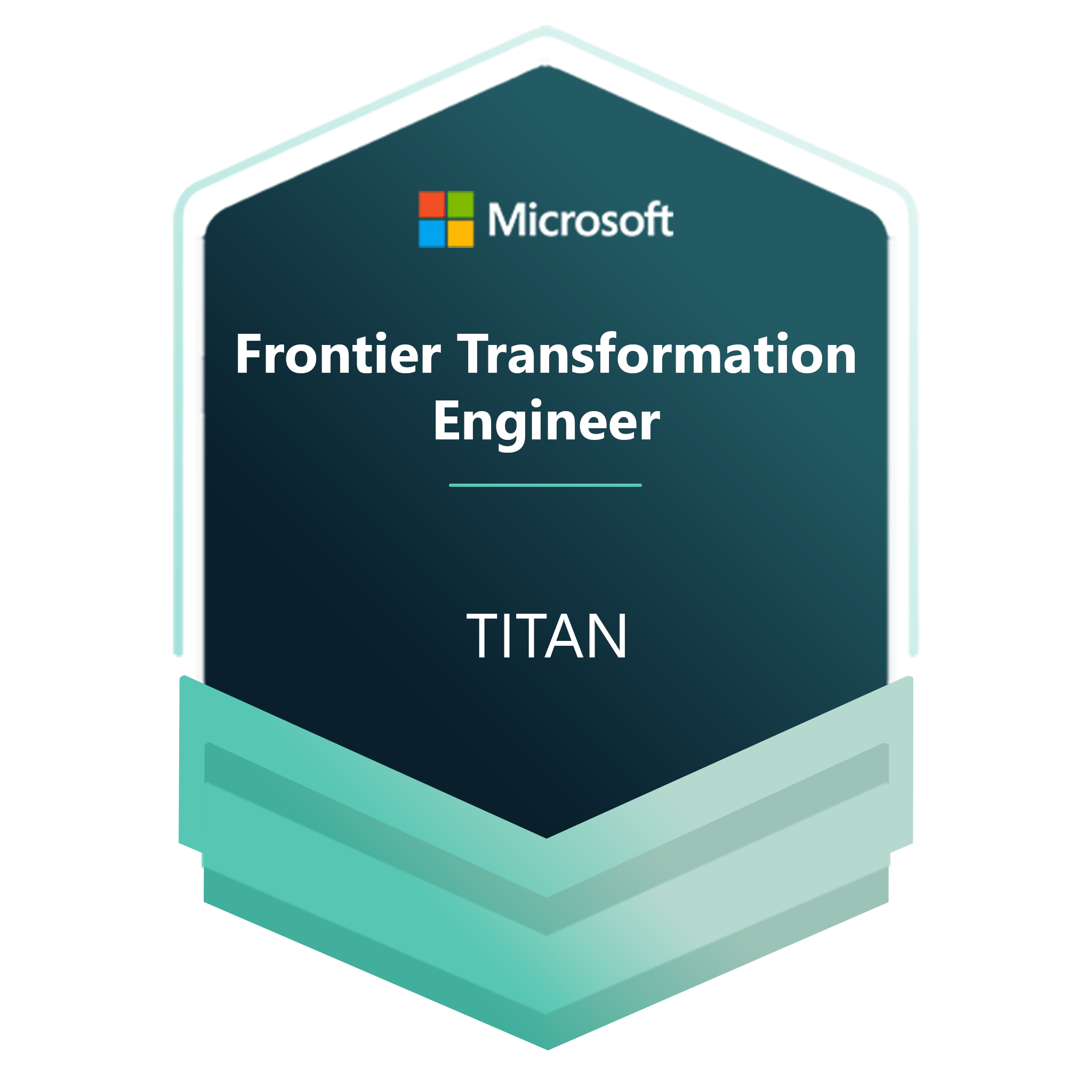
I have received my Microsoft Frontier Transformation Engineer badge
On 22 October 2026, I received the Frontier Transformation Engineer badge from Microsoft, at the TITAN level. It’s a milestone I’m proud of, and I want to share it with the WhyAzure community.
This post covers what the badge is, why the idea behind it matters for anyone building on Azure, and what I’m taking away from it.
What the badge is
The Frontier Transformation Engineer badge is Microsoft’s credential for technical professionals who design, build and deploy AI solutions. The LevelUp Frontier page calls it “Microsoft’s elite credential for technical professionals leading the next era of AI-powered transformation” and aims it at solution engineers, AI engineers, cloud engineers, solution architects and technical consultants. You earn it by finishing a self-paced path that LevelUp describes as 11 courses, about 86 hours and three milestones.
Microsoft’s partner community announcement says the badge “recognizes partners building the capabilities to design, implement, and deliver Microsoft Frontier AI solutions” and can help a partner qualify for a Frontier Partner specialization recognition.
11courses
~86hours, self-paced
3milestones
80%assessment pass mark
These are the required items, by milestone. The official credential artwork below accompanies the three exam tracks:
GH-300
GitHub Copilot

AB-100
Agentic AI Business Solutions Architect

AI-103
Develop AI apps and agents on Azure
Badge reference: Microsoft Learn.
| Milestone | Required item | Type | Hours (as listed) |
|---|---|---|---|
| 1. Certifications | GH-300: GitHub Copilot | Exam | 10 |
| 1. Certifications | AI-103: Develop AI apps and agents on Azure (an active AI-102 is accepted instead) | Exam | 10 |
| 1. Certifications | AB-100: Agentic AI Business Solutions Architect | Exam | 10 |
| 2. Project Ready | Activate organizational intelligence with Microsoft IQ | Course + assessment | 1 |
| 2. Project Ready | Build Frontier Firm productivity with Work IQ, Copilot, & agents | Course + assessment | 16 |
| 2. Project Ready | Accelerate Agentic AI | Course + assessment | 15 |
| 2. Project Ready | Microsoft Fabric IQ & Data Agents | Course + assessment | 8 |
| 2. Project Ready | Implement Agent 365 to observe, govern, and secure AI apps, Copilot & Agents | Course + assessment | 12 |
| 3. Frontier CoE & Hypervelocity Engineering | Hypervelocity Engineering Framework | Course + assessment | 1.5 |
Source: LevelUp Frontier page, last updated on 23rd August 2026.
Each assessment needs a minimum score of 80% and can be retaken up to 10 times. The certifications are Microsoft exams, and the badge is issued once all required certifications and assessments are validated.
The name echoes the Frontier Firm idea in the next section, and the path matches it: it covers building AI apps and agents, architecting agentic business solutions, and governing agents once they run. I will let you know why it matters and its significance in the context of the Frontier Firm model in next secton.
Why it matters: the Frontier Firm shift
Microsoft expects every organization to be on the path to becoming a Frontier Firm within 2 to 5 years. In its 2025 Work Trend Index, Microsoft describes this as a firm built around “intelligence on tap”: AI agents that reason, plan and act, working with people in teams that are “AI-operated but human-led”.
The report describes three phases, and many organizations will sit in more than one at once:
- AI as assistant: AI helps people do their existing work better and faster.
- Agents as digital colleagues: agents take on specific tasks at human direction.
- Agents running processes: humans set direction, and agents run entire workflows, with people checking in as needed.
The survey numbers show how fast this is moving. Of the leaders surveyed, 82% called this a pivotal year to rethink strategy and operations, 81% expect agents to be moderately or extensively part of their AI strategy within 12 to 18 months, and 46% say their company already uses agents to fully automate some workflows.
For anyone working on Azure, the practical question follows: someone has to design, secure and run all of those agents and workflows. That is the gap a transformation engineer fills.
What I’m taking away
The biggest lesson is to think in outcomes and workflows first, and in models and services second. Three ideas from the Frontier Firm framing shape how I now approach this work:
- Start from the outcome. The Work Trend Index suggests the org chart may give way to a “Work Chart”, with teams forming around goals rather than departments. For an engineer, that means designing around a business result and choosing services after.
- Keep humans in charge. “AI-operated but human-led” is a design requirement. Approvals, audit trails and clear hand-offs belong in the architecture from day one. The path reflects this: one of its five Project Ready courses covers how to observe, govern and secure AI apps, Copilot and agents with Agent 365.
- Plan for agents and people together. The report proposes a “human-agent ratio”: how many agents a role needs and how many humans it takes to guide them. It is a useful question to ask of any workflow you automate.
I would like to thanks Microsoft BU from HCLTech who has informed and enabled me for this program, and my Boss who has approved my special dedicated time for this learning journey. I am also grateful to my colleagues and mentors who have supported me throughout this learning path. Finally, I would like to thank my family for their encouragement and understanding during this learning journey.
If you want to follow the same path
Get your setup and exam plan sorted first, then practise on one real workflow.
- Set up your profiles first. Register on the Partner Skilling Hub with a work email (personal emails aren’t supported), then link your Microsoft Learn and Partner Center profiles so the badge counts toward your organization. The LevelUp page lists the four steps. New certifications can take 2 to 3 weeks to show up.
- Check voucher options early. In a reply on Microsoft’s partner community dated 30 September 2026, Microsoft said the ESI Partner Program offers 50% discounted vouchers and there is no free voucher program for all partners. Your Partner or Account Manager can tell you whether you qualify.
- Join the Fastrack Support Series. It runs from 26 October to 10 November 2026 with 8 live sessions (14 live hours), exam prep for GH-300, AI-103 and AB-100, and two assessment accelerators. Live sessions start at 9 AM IST.
- Practise on one real workflow. Pick something repetitive with clear inputs and outputs, add human checkpoints before you automate, and measure time saved or error rate before and after.
- Share what you learn. Writing it up forces clarity and helps others on the same path.
A badge is a snapshot, and this field moves quickly, so keep building after you earn it.
What’s next
Next, I plan to put these ideas to work on real AI projects and write about what I learn here on WhyAzure. I would like to continue acknowledging the support from Microsoft, my mentors, colleagues, and family as I embark on this next phase of my learning journey.
If you want to start, the full path is laid out on the LevelUp Frontier page.
If you’re working toward this badge or building agents on Azure, tell me in the comments what you’re stuck on. And if someone you know is on the same path, share this post with them.

Charter Member MCSE Certificates for the Cloud Platform and Infrastructure and the difference with non-charter MCSE Certificate

Became Azure Master for Feb. 2018

WhyAzure has been listed among Top 50 Microsoft Azure Blogs, Websites & Influencers in 2021
About Author
